
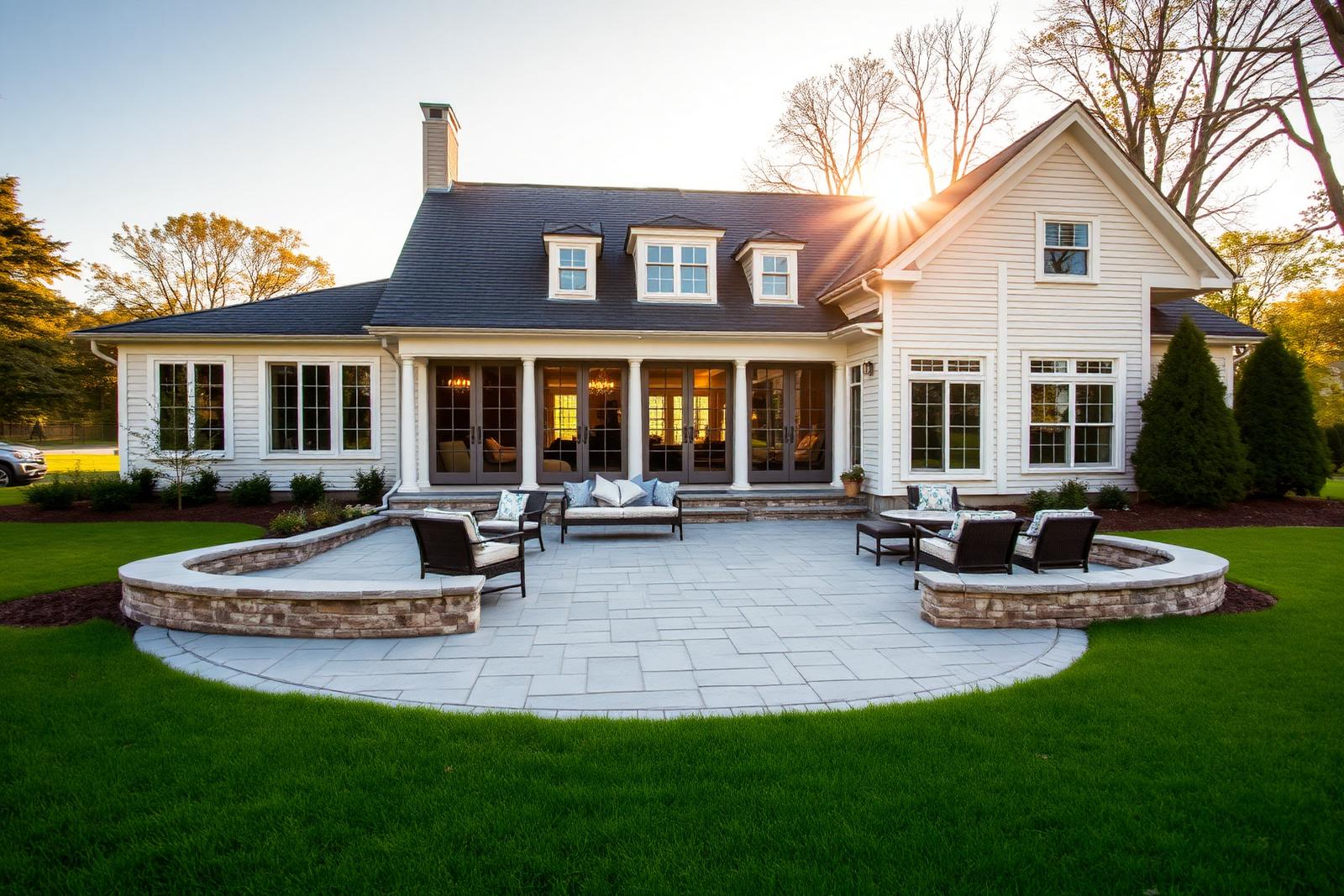
Paver Patios · New Hampshire & Florida
Custom Paver Patios Built to Outlast the Weather
A patio is the floor of your outdoor living room. Get the base right and it looks new for thirty years. Get it wrong and it sinks in three.
Paver Patios
Most of the failed patios we get called out to look at were not built with bad pavers. They were built on a bad base. A paver patio is a flexible pavement system — the pavers themselves are only the top three-eighths of the equation. Underneath sits an excavated subgrade, a compacted aggregate base, a screeded bedding layer, and a joint-stabilization system that locks the whole field together. Skip a step or shortcut a depth and the surface tells on you within a couple of seasons.
NH Hardscapes has been designing and installing paver patios since 2015, for homeowners across southern New Hampshire and the greater St. Petersburg, Florida area. We do our own excavation, our own base prep, and our own laying. Nothing about your patio gets handed to a subcontractor who was never on the design walk-through and will never see the finished job.
The design conversation comes before the shovel
Before we quote anything we walk the property with you. Where does the afternoon sun land? Where does water go after a heavy rain? How far is it from the kitchen door to where you actually want the grill? Which neighbor's window are you trying to screen out? These are the questions that determine whether a patio gets used every weekend or sits empty because it's in the wrong spot.
We size patios around furniture, not around square footage targets. A dining zone that seats six needs roughly 12 by 14 feet once you account for chairs pulling back. A conversation area with a fire feature wants a 16-foot minimum diameter. A grill station needs landing space on both sides. We sketch the layout on-site, mark it out with paint, and let you stand in it before a single stone is ordered.
- On-site design walk with sun, drainage, and traffic-flow review
- Painted layout so you can walk the footprint before committing
- Material samples brought to your property, under your light
- Elevation and step planning tied to existing doors and grade
What actually goes under your pavers
Excavation depth depends on soil and climate. In New Hampshire, where frost drives deep and clay pockets hold water, we typically excavate 10 to 14 inches below finished grade for a patio and deeper for anything vehicles will touch. In Florida's sandy soils the depth is less about frost and more about compaction and washout resistance, so the base recipe changes accordingly.
The subgrade gets compacted before anything goes on top of it. Then processed gravel goes down in lifts — never one deep dump — with a plate compactor or reversible-plate machine run over each lift. Compacting in lifts is the single most skipped step in residential hardscaping, and it is the reason so many patios develop low spots. A properly compacted base has almost no settlement left in it.
On top of the base goes a one-inch screeded bedding course of coarse concrete sand or high-performance bedding aggregate, laid to a consistent depth and never used to fix an uneven base. Pavers are set into that bedding, cut to the layout, edge-restrained on every open side with spiked polymer or concrete edging, then vibrated in and locked with polymeric joint sand.
- Excavation to true depth — no shortcutting for soft soil
- Geotextile separation fabric where subgrade conditions call for it
- Aggregate base compacted in lifts, not one pass
- Screeded bedding course at consistent depth
- Edge restraint on every unsupported edge
- Polymeric joint sand, swept, watered, and cured properly
Thinking about paver patios?
We'll walk your property, talk through options, and give you an itemized written price. No cost, no pressure.
Drainage is designed, not hoped for
Every patio we build is pitched. The standard is roughly a quarter inch of fall per running foot, always away from the foundation. That slope is imperceptible underfoot and it is the difference between a dry patio and a patio with a permanent puddle by the back door.
Where a patio sits below grade, against a walkout, or in a low corner of the yard, pitch alone is not enough. We build in the drainage the site needs: channel drains at door thresholds, catch basins tied to solid pipe, French drains behind retaining features, and daylighted outlets that actually go somewhere. We would rather add a drain during construction than come back and cut one in after your first spring.
Patterns, borders, and the details people notice
The layout pattern does more work than most homeowners expect. Running bond reads calm and modern. Herringbone at 45 degrees interlocks the strongest and is the right call anywhere loads are heavier. Ashlar and random-modular patterns using three or four stone sizes read as natural stone and hide minor color variation beautifully.
Borders frame the field and give the eye somewhere to land. A soldier course in a contrasting tone, a double border on a large patio, a curved band that echoes the house line — these are small material costs that make an enormous visual difference. Inlays, banding, and circle kits are all on the table.
We also plan the boring things that separate a professional job from a weekend one: full-size cuts at visible edges instead of slivers, sleeving for future lighting and gas lines run before the pavers go down, and a stone layout that puts your cleanest cuts where people walk.
Integrating the rest of your outdoor living space
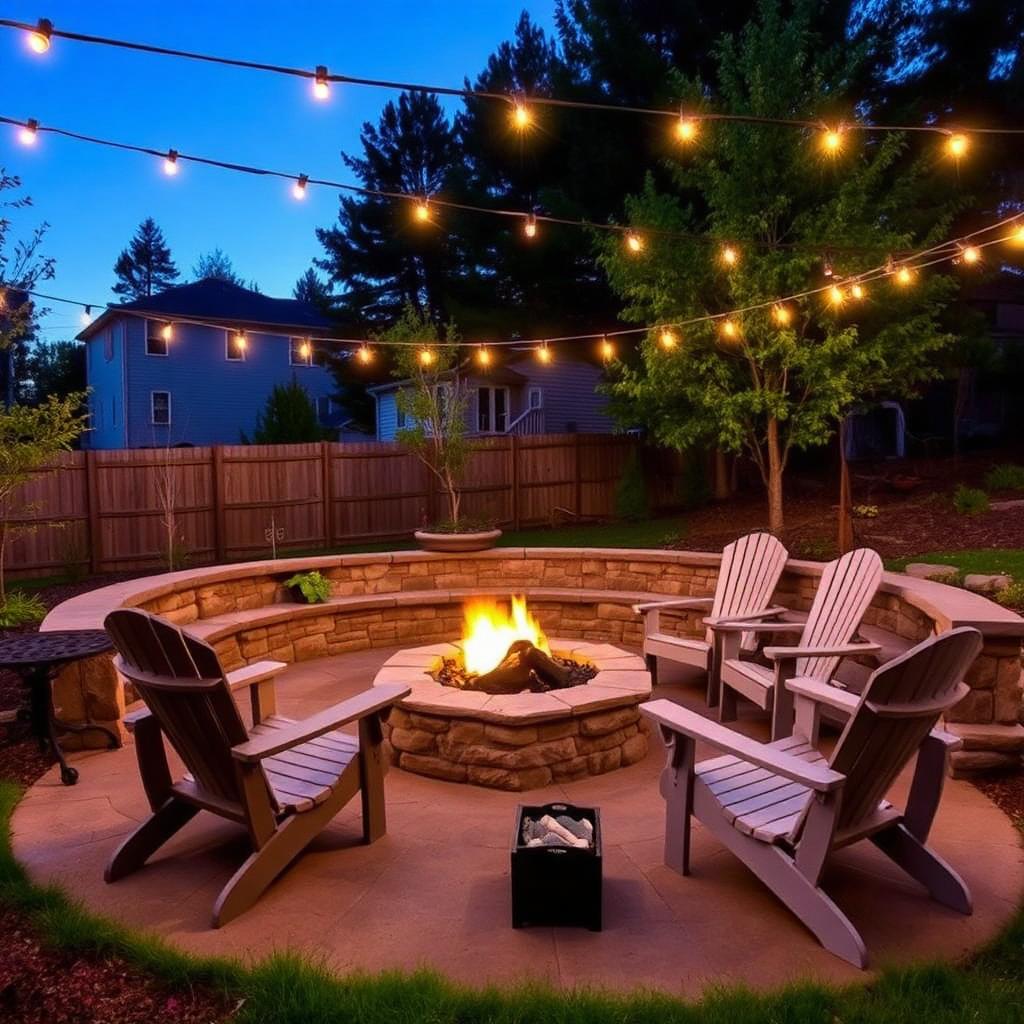
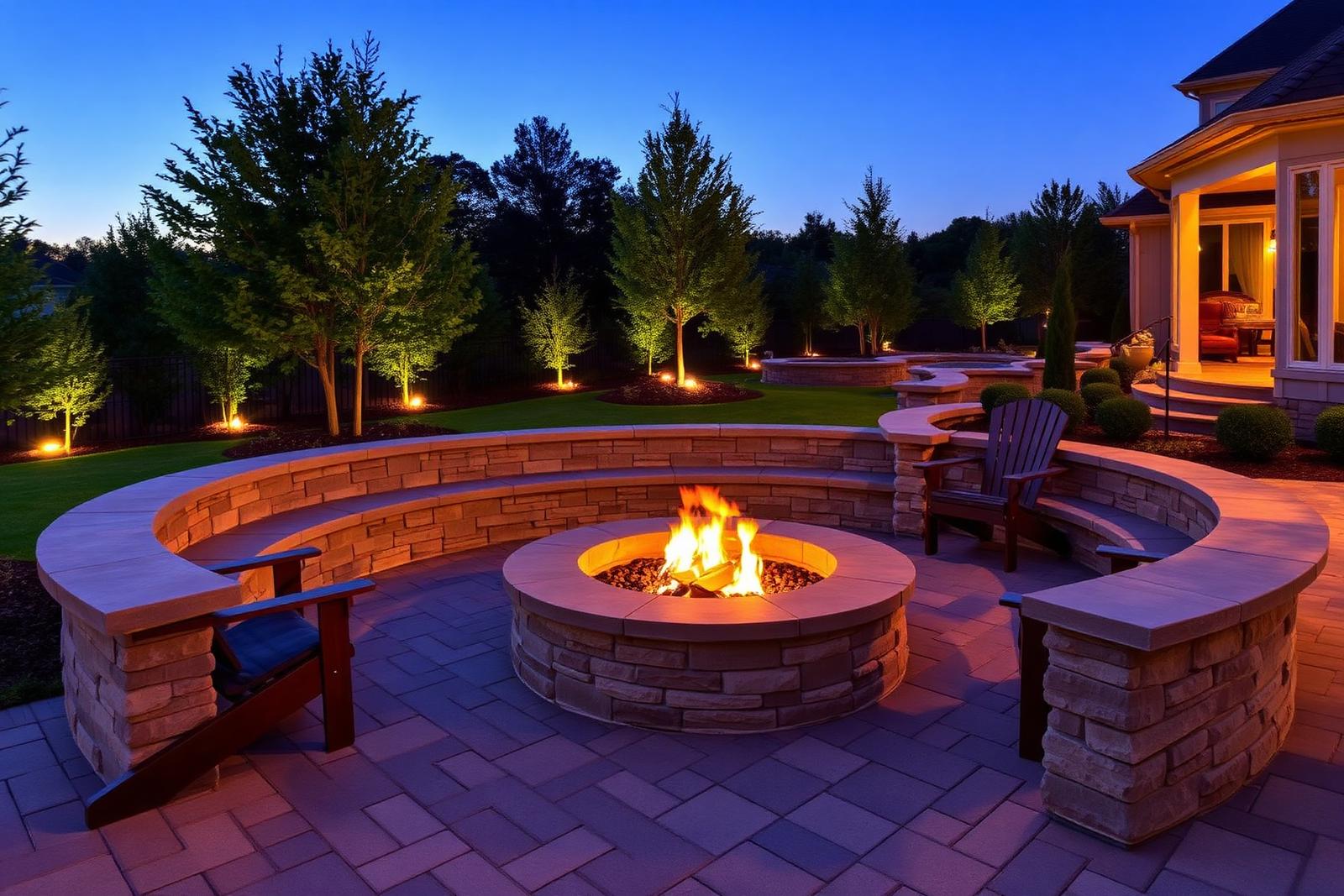
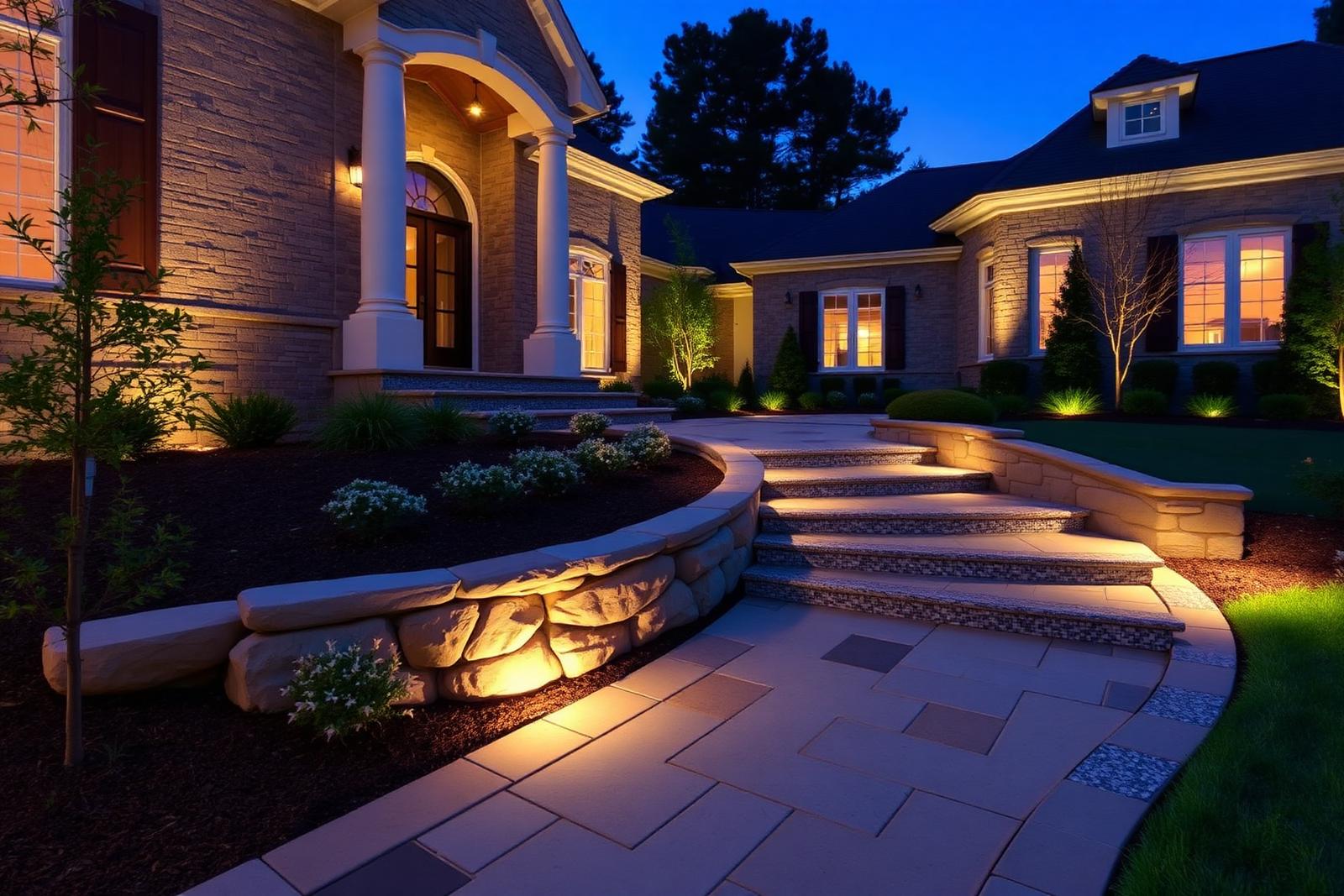
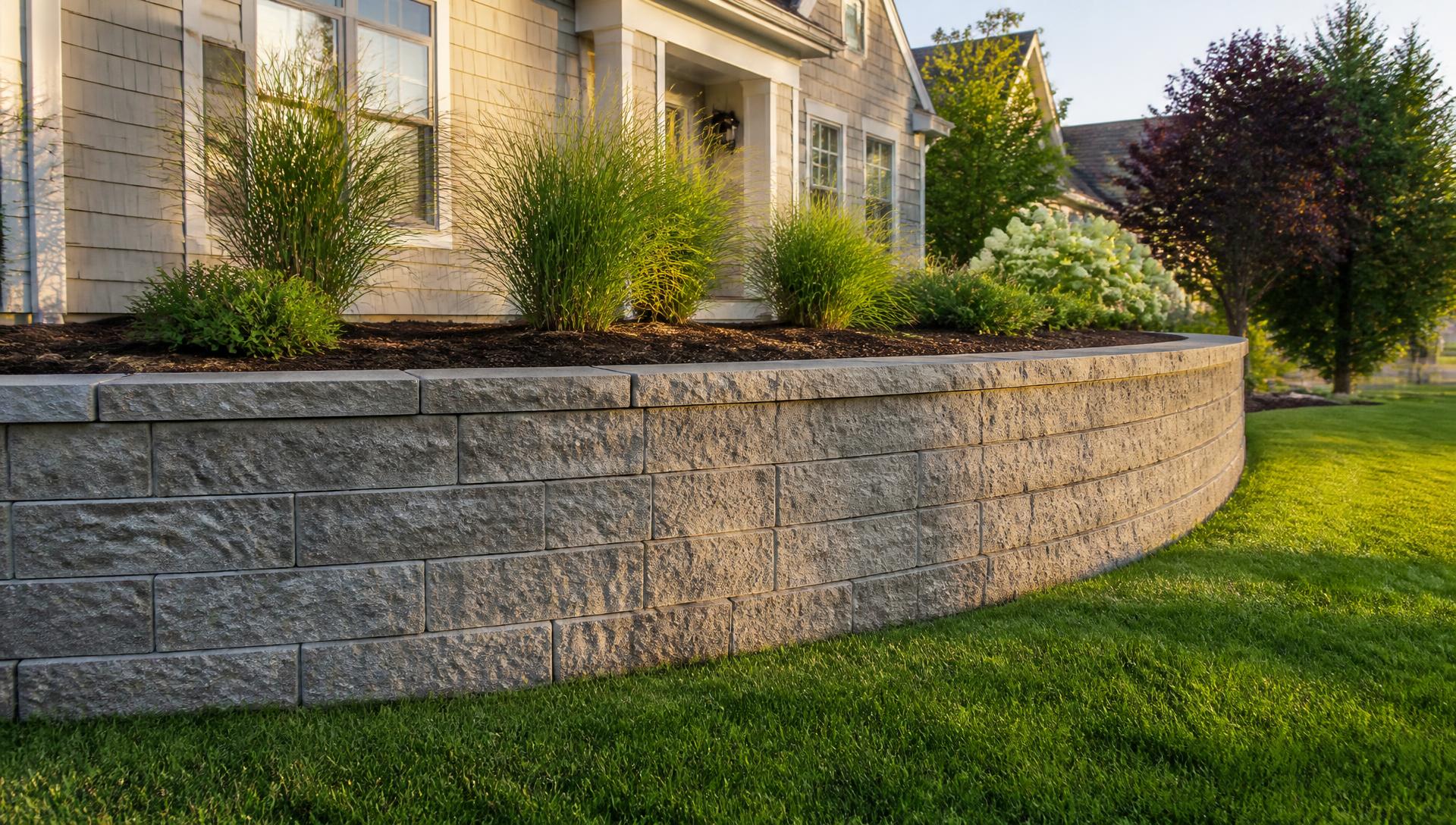
A patio is rarely the whole project. Most of ours arrive with a sitting wall, a set of steps, a fire feature, or a walkway that ties the front of the house to the back. Building those elements at the same time is meaningfully cheaper than adding them later — the excavator is already on site, the base is being built anyway, and utilities can be sleeved before anything is closed up.
If your budget only covers the patio this year, tell us. We will design the full space now and build it in phases, sleeving conduit and stubbing gas so next year's fire pit or outdoor kitchen doesn't mean cutting into finished work.
Materials
What we build with
Concrete pavers
The workhorse. Modern premium concrete pavers offer through-color, dense face mixes, and dozens of textures — from tumbled old-world to sharp modern slabs. Best value per square foot and the widest design range.
Natural bluestone
Full-color or select-blue Pennsylvania bluestone, thermal or natural cleft. Unmistakably New England, cool underfoot, and gorgeous with a granite border. Available as pattern-cut flagging or irregular.
Granite
New England granite as treads, borders, and curbing. Nearly indestructible and the strongest visual tie to classic regional architecture.
Travertine
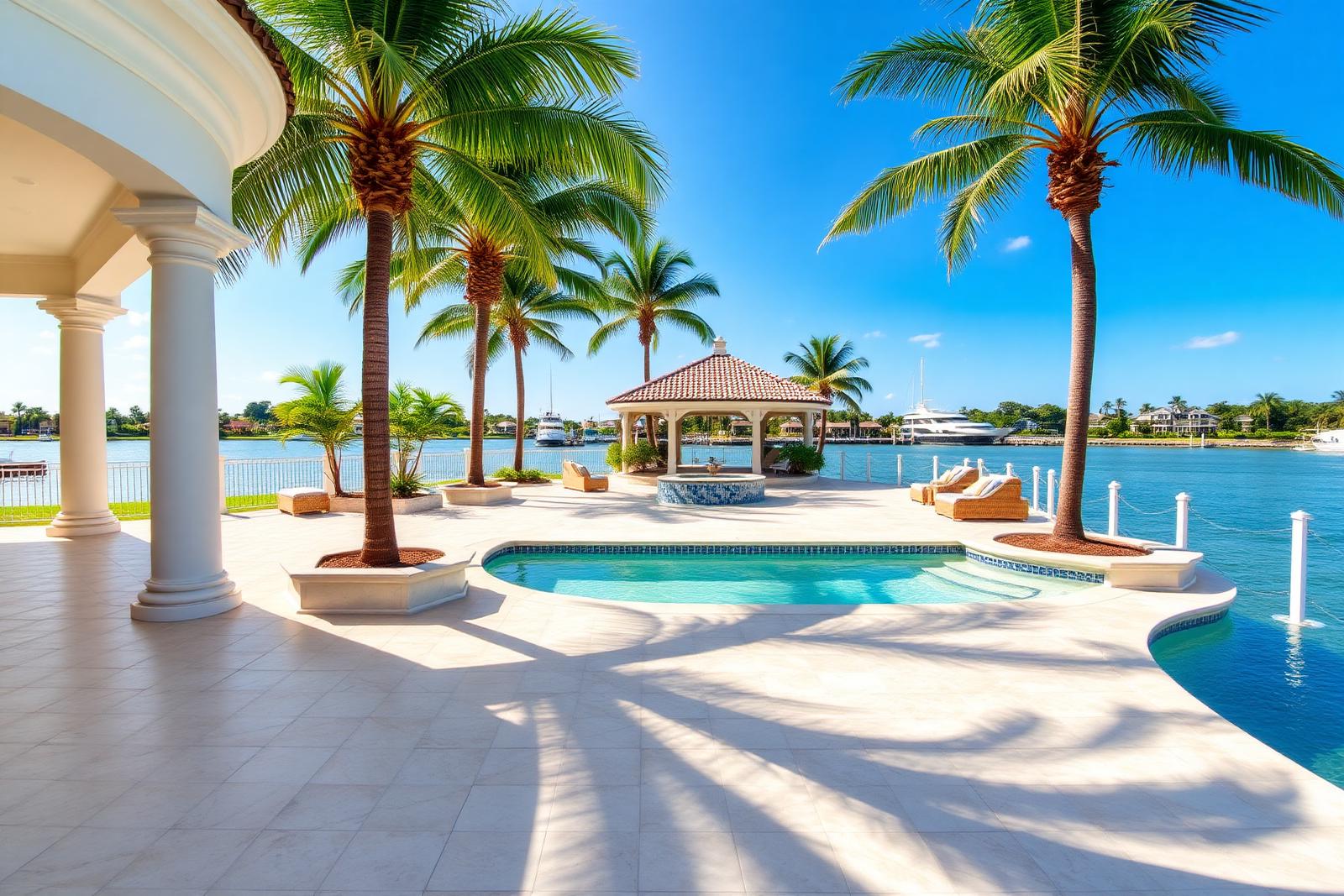
Our most-requested Florida surface. Stays remarkably cool in direct sun, sheds water fast, and reads high-end around pools. Ivory, silver, and walnut tones.
Porcelain pavers
2cm outdoor porcelain in wood-look and concrete-look finishes. Extremely stain-resistant, zero-maintenance color, and the crispest modern lines available.
Permeable systems
Where drainage or stormwater regulation is a factor, permeable pavers let water pass through the joint into an open-graded stone reservoir below.
Two very different climates
Built for where it's going
Building patios for New Hampshire winters
New Hampshire's freeze-thaw cycle is brutal on rigid pavement. Poured concrete cracks because it cannot move. A paver patio can — that flexibility is exactly why it's the right system here. The base absorbs frost movement and the joints let individual units shift a hair and settle back.
What makes that work is drainage. Water that cannot leave the base is water that will freeze, expand, and lift. Our New Hampshire builds run deeper bases, more open-graded aggregate where conditions warrant, and separation fabric over clay-heavy subgrade. We also plan for winter service: a properly built paver patio can be shoveled and plowed, and if a plow ever clips a corner, we can lift and reset individual pavers instead of replacing a slab.
One more New England detail — use calcium chloride or a paver-safe deicer, not rock salt with heavy chloride content, on brand-new concrete pavers through their first winter.
Building patios for Florida sun, salt, and rain
Pinellas County brings a different set of problems: relentless UV, salt air off the Gulf, sandy subgrade, and rainy-season downpours that can drop several inches in an afternoon.
We specify UV-stable, non-yellowing sealers for Florida installs and choose light-toned materials — travertine and ivory-tone pavers — that stay walkable barefoot in August. Sandy subgrade compacts well but migrates, so separation fabric and solid edge restraint matter more, not less. And every Florida patio is designed around the assumption that it will need to move a serious volume of water in a very short window.
Around pools and in coastal zones we detail for salt exposure and pool chemistry, and keep expansion and movement joints where the hardscape meets pool coping and structural slabs.
Investment
What paver patios typically cost
Most New Hampshire paver patio projects land between $22 and $40 per square foot installed, depending on material, access, excavation depth, and how much drainage or wall work the site requires.
Florida travertine and premium paver pool decks typically run $18 to $34 per square foot installed.
Those ranges are honest starting points, not the number on your estimate. Site access, existing surface removal, grading, drainage, steps, walls, and lighting all move it. We give you a written, itemized price after we walk your property — no square-foot guessing over the phone.
Get your itemized estimateGood to know
Paver Patios: your questions answered
How long does a paver patio installation take?+
Most residential paver patios take 3 to 7 working days on site. Larger projects that include retaining walls, steps, a fire feature, or significant drainage work typically run 1 to 3 weeks. Weather and material lead times are the two variables we can't fully control, and we'll tell you about both up front.
Are pavers better than a poured concrete patio?+
For our climates, yes — for two reasons. Pavers flex with frost movement instead of cracking, and individual units can be lifted and reset if a utility needs access or a section ever settles. Concrete has to be cut out and repoured, and the patch never matches. Pavers also offer far more design range in color, texture, pattern, and border detail.
Will my patio sink or shift over time?+
Not if the base is right. Settlement is a base-prep failure, not a paver failure. We excavate to full depth, compact aggregate in lifts, and edge-restrain every open side. Every patio we install carries our 5-year workmanship warranty, which covers exactly this.
Do paver patios need sealing?+
Sealing is optional and it's a look-and-maintenance decision, not a structural one. A sealer deepens color, makes spills easier to clean, and helps hold joint sand. It also needs reapplication every 3 to 5 years. In Florida we recommend a UV-stable sealer more often than in New Hampshire because of sun exposure. We'll give you a straight recommendation for your specific material.
Can you build a patio over my existing concrete slab?+
Sometimes. If the slab is structurally sound, properly pitched, and the resulting height still works with your door thresholds, an overlay is possible. More often the slab is cracked, pitched wrong, or would raise the finished surface too high — in which case removing it and building a proper base is the better long-term call. We'll tell you honestly which situation you're in.
What maintenance does a paver patio need?+
Very little. Sweep it, rinse it, pull the occasional weed at the perimeter, and re-sand the joints every several years as polymeric sand slowly weathers. Pressure washing should be done at low pressure and a wide fan so you don't blast the joint sand out. That's the whole list.
Do you offer free estimates?+
Yes — free, on-site, no-pressure. Call (603) 508-4681 or send the estimate form and we'll schedule a visit at your property.
Related services
Often built together
Let's build it right the first time
Free on-site consultation across southern New Hampshire and Pinellas County, Florida. 5-year workmanship warranty on everything we install.